**Click here to find your perfect jewellery gift in less than 15 seconds & SAVE 5%**


How Rare is My Coin? UK Coin Rarity Checker
Most of us have picked up a coin at some point and wondered if it might be something special. A 50p with an unusual design, an old penny that looks different from the ones in general circulation, a coin your grandparent kept in a tin for reasons nobody quite remembers. The question is always the same. Is this coin rare, and if so, how rare?
Our free UK Coin Rarity Checker gives you a straight answer, built entirely on figures published by The Royal Mint. Enter your coin’s denomination and year, and the tool will tell you whether it matches a known rarity, and what makes it rare if it does. It also tells you honestly when a coin isn’t a documented rarity, because most coins, even old ones, aren’t.
H2: UK Coin Rarity Checker
Is My Coin Rare? UK Coin Rarity Checker
Select your coin's denomination and year to find out whether it's a known rarity, backed by figures published directly by The Royal Mint.
How do I know if my coin is rare?
A coin’s rarity comes down to three things. How many were made (the mintage figure), how many have survived in good condition, and how much collectors want that particular design. The Royal Mint publishes mintage figures for every UK coin, and as a general rule, circulating coins with a mintage under 250,000 are considered genuinely rare, those between roughly 250,000 and one million are scarce, and anything above a few million is common, however unusual it might look.
Age on its own tells you very little. Some Victorian coins were struck in their hundreds of millions and remain common today, while some coins from the last twenty years are genuinely scarce because so few were made. The mintage figure, not the year, is what actually determines rarity.
Which UK coins are actually rare?
A small number of coins account for almost everything people are searching for when they ask this question. Here are the ones worth knowing by name.
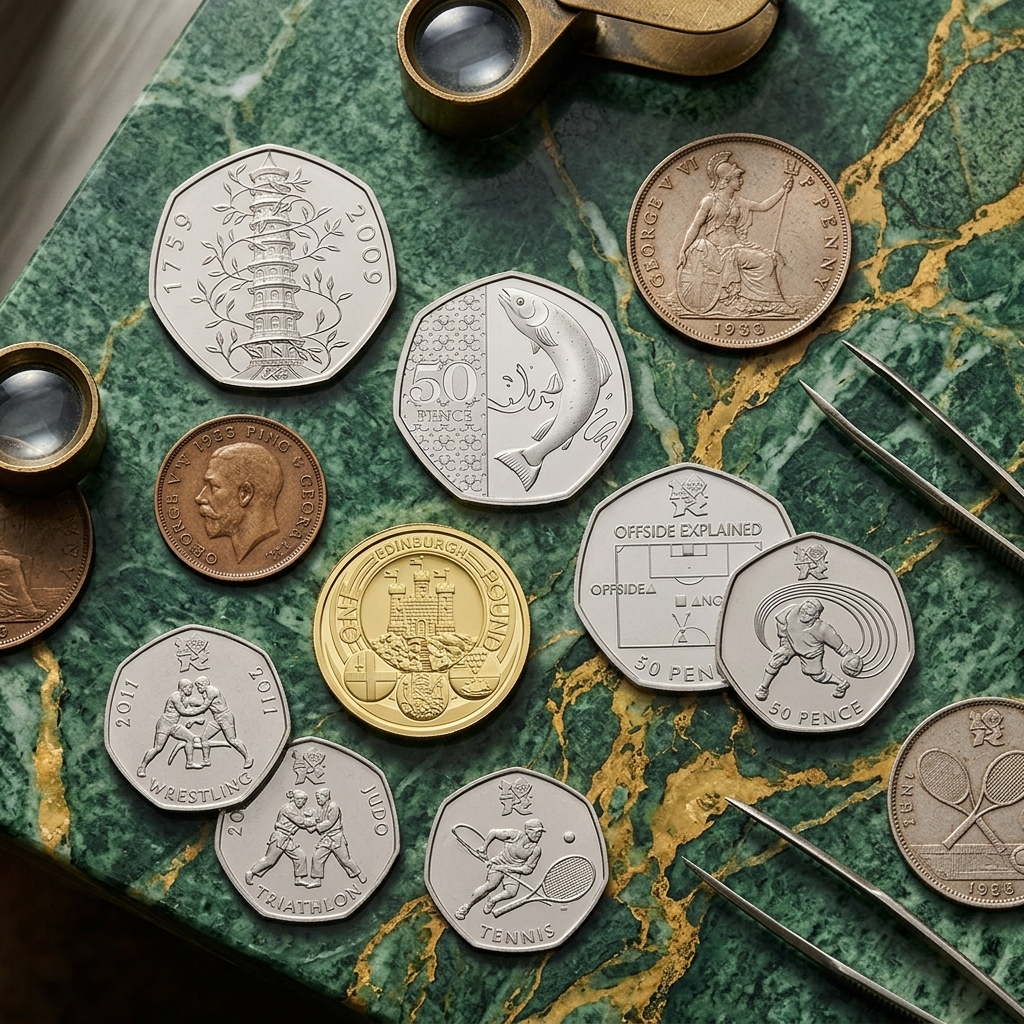
1) The Kew Gardens 50p
Issued in 2009 to mark the 250th anniversary of the Royal Botanic Gardens, the Kew Gardens 50p was struck to a mintage of just 210,000, making it the rarest circulating 50p for 14 years. Its design features the garden’s famous Chinese Pagoda. Genuine examples in good condition regularly change hands for well above face value.
2) The Atlantic Salmon 50p
The current title holder. Entering circulation in late 2023 as part of King Charles III’s definitive coin designs, the Atlantic Salmon 50p was struck to a mintage of 200,000, narrowly overtaking Kew Gardens as the rarest 50p you could realistically find in your change.
3) The 1933 Penny
Britain’s single most famous rare coin, and one you are very unlikely to ever hold. The Royal Mint confirms only six were struck, three placed beneath the foundation stones of buildings and three kept for national collections. None were released into general circulation. If you believe you have found one, treat it with real caution. Genuine examples are worth five to six figures, and the coin’s fame means fakes are common.
4) The Edinburgh City £1
Confirmed by the Royal Mint as the rarest £1 coin ever struck for circulation. It’s worth knowing, though, that this is a round £1 coin, and all round £1 coins were formally withdrawn in 2017 when the 12-sided design was introduced. You will not find this one in your pocket today, only in existing collections. Among £1 coins still in active circulation, the rarest is the 2022 Queen Elizabeth II final-portrait design, struck to 7,735,000.
For a full list and details of the most rare UK coins, check our guide.
Coin rarity myth debunked
The 1973 EEC 50p is often assumed to be rare because it was the very first commemorative 50p ever issued. In fact, with almost 90 million struck, it’s one of the more common designs you’ll find. Being the first of something and being rare are not the same thing.
Coins to check for in your change
If you’d rather skim than search coin by coin, here’s the full list of confirmed rarities worth a second look:
- 2023 Atlantic Salmon 50p: mintage 200,000, the current rarest circulating 50p
- 2009 Kew Gardens 50p: mintage 210,000, rarest 50p for 14 years before the Atlantic Salmon
- 2011 Olympic 50p designs: Football, Wrestling, Judo, Triathlon, Tennis and Goalball, all between 1.1 and 1.6 million
- 2018 Peter Rabbit and Flopsy Bunny 50p: mintage 1.4 million each
- 2015 Britannia £2 (first release): mintage 650,000
- 2002 Commonwealth Games England £2: mintage 650,000
- 2008 Olympic Handover and Centenary £2 designs: mintage 910,000 to 918,000
- 2022 Queen Elizabeth II final-portrait £1: mintage 7,735,000, the rarest £1 currently in circulation
- 2011 Edinburgh City round £1: the rarest £1 ever struck, though withdrawn from circulation in 2017
- 2019 W, Y and Z alphabet 10p coins: mintage 63,000 each, three times rarer than Kew Gardens
- 2023 Dormouse 1p: mintage 600,000, the first King Charles III definitive 1p
- 1933 Penny: only six confirmed to exist, essentially never found in change
Disclaimer: every figure above is checked against The Royal Mint’s own published records. Search your specific coin above for the full story behind each one.
What are UK coin minting errors?
Rarity through low mintage is one story. Rarity through a genuine mistake at the mint is another, and it tends to produce the coins with the most colourful histories.
An error coin is exactly what it sounds like, a coin that left the Royal Mint with something wrong that shouldn’t have made it through quality control. Two confirmed examples worth knowing:
- The 2008 undated 20p: When the 20p’s design changed in 2008, the year moved from the reverse to the obverse for the first time in the coin’s history. A batch of dies mismatched an old reverse with a new obverse, and the result was 20p coins with no year printed anywhere on them at all, the first undated UK circulating coin design mismatch of its kind in decades. It’s since become one of the most talked-about modern British error coins.
- The 1983 “NEW PENCE” 2p: The wording on 2p coins changed from “NEW PENCE” to “TWO PENCE” in 1982, once the currency no longer needed the “new” reminder. A small number of 1983-dated coins were mistakenly struck with the outdated wording, to Brilliant Uncirculated standard, intended only for collector sets.
Error coins are valued differently from low-mintage rarities. It isn’t about how many were made, it’s about how few carry the specific mistake, which is often genuinely unknown rather than officially published. If you think you have found a coin with an error like this, a specialist dealer or a submission to a grading service is the right next step, since authentication matters enormously here.
Why are pre-decimal coins generally scarcer today?
If you’re holding a farthing, a threepence, or an old shilling, it’s worth understanding why pre-decimal coins as a whole tend to be harder to find than their mintage figures alone would suggest, even when no individual date is a documented rarity.
Britain moved to decimal currency on 15 February 1971. Pre-decimal coins stopped being usable in shops from that point, with the sixpence given a short reprieve until 1980. Once a coin can no longer be spent, its story usually goes one of two ways. It gets kept, in a drawer or a collection, or it gets melted down. Coins struck before 1947 in particular were made from sterling silver, and as the price of silver rose over the twentieth century, vast quantities were melted purely for their metal content rather than kept as currency.
The result is that pre-decimal coins as a category have simply survived in smaller numbers than their original mintage figures suggest, even for years and denominations that were common when first struck. That’s a different thing from any specific date being rare, and it’s why the mintage figure remains the more reliable guide. A farthing from a huge mintage year is still likely to be common. It’s simply less likely to still exist in the same proportion it once did.
My coin isn’t rare. Does that mean it’s worthless?
Not at all, and this is worth being genuinely clear about. Most coins, even coins that are decades old, were minted in large enough numbers that they don’t carry meaningful resale value beyond their face value or a small collector premium. That’s simply how currency works. A coin needs to be scarce to be financially valuable, and the vast majority were made to be spent, not collected.
But rarity and meaning are two different things. A coin doesn’t need to be worth a great deal to be worth keeping. A genuine coin from a specific year, a birthday, a wedding, the year someone was born, carries a kind of significance that has nothing to do with mintage figures.
At Heads & Tails, we handcraft coins like these into keyrings, cufflinks, necklaces and more, precisely because their value lies in what they represent rather than what they’d fetch at auction. If your coin turned out to be common rather than rare, that’s not a disappointing result. It’s the reason coin jewellery exists in the first place.
See coin jewellery by year at www.headsandtailsjewellery.co.uk
Where can I sell a genuinely rare coin?
If your coin does match one of the known rarities, we’d always recommend a specialist rather than a general marketplace. Reputable options include established auction houses such as Spink, Noonans, and Baldwin’s, all of which handle British coins regularly and can advise on authentication and likely value. For a straightforward valuation without committing to a sale, a local accredited coin dealer or a submission to a grading service such as PCGS or NGC is a sensible first step.
We’re a jewellery maker, not a coin dealer, so we won’t buy or value your coin ourselves, but we’re always happy to point you toward people who can.
Related tools and guides
- UK Coin Age Calculator
- Top 10 Rarest 50p Coins
- Best British Jewellery Brands
- Shop coin jewellery by year
Frequently asked questions
How can I tell if my coin is rare?
For a quick and free check, use our proprietary tool on this page. If you want to do it manually, check its denomination and year against a source that publishes verified mintage figures, such as The Royal Mint’s own rare coins pages. As a general guide, circulating coins with a mintage under 250,000 are considered rare, and those under a million are scarce.
What is the rarest 50p coin?
The 2023 Atlantic Salmon 50p, with a mintage of 200,000, is currently the rarest 50p in circulation. It overtook the 2009 Kew Gardens 50p, which held the record for 14 years with a mintage of 210,000.
What is the rarest £1 coin?
The 2011 Edinburgh City round £1 is confirmed by the Royal Mint as the rarest £1 ever struck for circulation. It’s no longer in circulation, however, since all round £1 coins were withdrawn in 2017. Among coins you could still find in your change, the 2022 Queen Elizabeth II final-portrait £1 is the rarest, with a mintage of 7,735,000.
Is the 1933 penny real?
Yes, but only six are confirmed to exist, and none were released into general circulation. They were struck for ceremonial purposes, including being placed beneath building foundation stones. Any 1933 penny found in ordinary change is almost certainly not genuine.
Does an old coin automatically mean it’s valuable?
No. Age alone doesn’t determine value. Mintage figures matter far more. Some Victorian and Edwardian coins were struck in huge numbers and remain common, while some coins from the last decade are genuinely scarce.
What should I do if my coin isn’t in your database?
It’s most likely a standard circulation coin, minted in large numbers, which is true of the vast majority of UK coins. Our database covers documented, verified rarities rather than every coin ever struck, so an absence isn’t evidence either way, only that it isn’t a widely recognised rarity.
Can I turn my coin into jewellery even if it isn’t rare?
Yes, and this is exactly what Heads & Tails specialises in. We handcraft genuine UK coins from any year, 1901 to the present, into keyrings, cufflinks, necklaces and more. The coin doesn’t need to be rare to make a meaningful, personal gift.